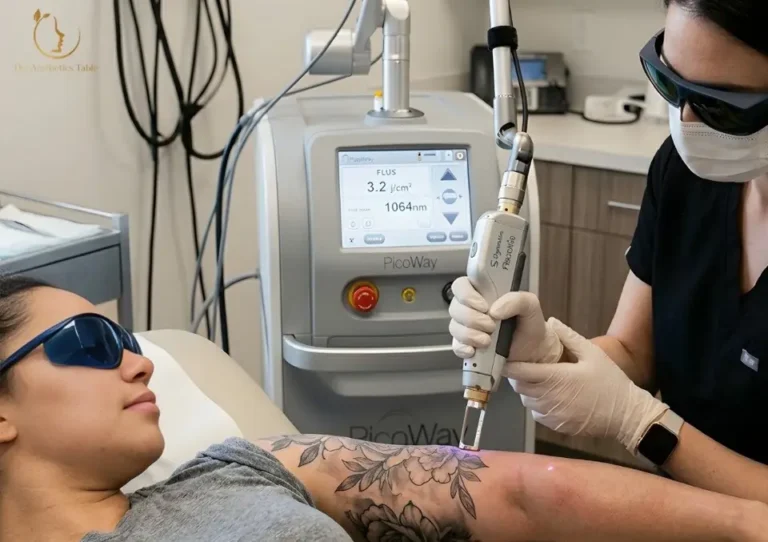
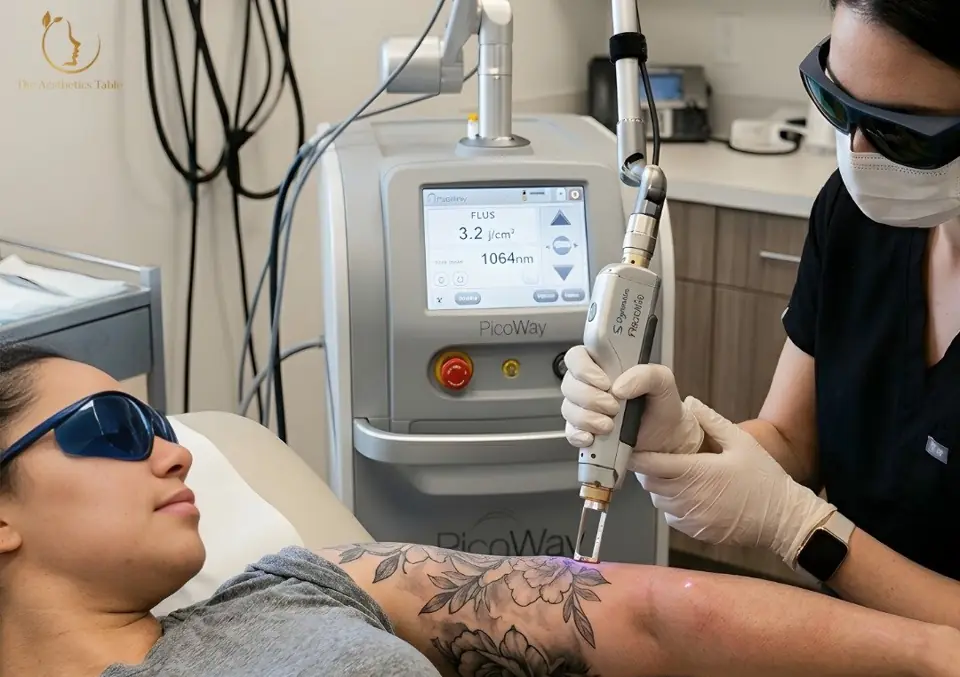
There is no single number of laser tattoo removal sessions that suits every tattoo. Most people need a course of several treatments spaced weeks apart, which is why our prices include a course of 8. A small, older, black tattoo may fade faster, while a dense, colourful or professionally layered piece usually needs more. Your plan is built around your tattoo at consultation.
How laser removal fades ink between sessions
Tattoo ink sits in the deeper layer of the skin as particles too large for your body to clear on its own. During treatment, very short pulses of laser energy shatter those particles into smaller fragments. Over the following weeks, your immune system gradually carries the fragments away.
That clearing process is the real reason removal takes time. Much of the fading happens between appointments, not during them. Treating again too soon does not speed things up and can increase the risk of irritation, so sessions are usually spaced several weeks apart to let your skin heal and your body do its work.
What decides how many sessions you need
When we assess a tattoo, these are the main things we look at:
| Factor | Tends to need fewer sessions | Tends to need more sessions |
|---|---|---|
| Ink colour | Black and dark blue | Green, light blue, yellow, white and pastel shades |
| Ink amount | Fine lines, light shading | Solid fill, dense or layered ink |
| Who did it | Amateur tattoos, often with less ink | Professional tattoos, usually with more ink placed deeper |
| Age | Older tattoos that have already softened | Newer, sharper tattoos |
| Location | Areas closer to the centre of the body | Hands, ankles and feet, where circulation is slower |
| Cover-ups | Single tattoo | Tattoo over another tattoo |
Your general health also plays a part. Because the immune system clears the ink, things that affect circulation and healing, such as smoking, may slow progress. Skin tone matters too, as the settings need to be chosen carefully to protect the surrounding skin.
Removal, or fading for a cover-up?
It is worth deciding early what you want from treatment, because it affects how many sessions you are likely to need.
- Full removal aims to fade the tattoo as far as possible. It usually takes the longest, and some people are left with a faint shadow, known as ghosting, even after a full course.
- Fading for a cover-up aims to lighten the old design enough for a tattoo artist to work over it. This often needs fewer sessions, and your artist can advise when the area is light enough.
- Partial removal targets one part of a design, such as a name or a section of lettering.
If you are not sure which route suits you, we can talk it through at your appointment. For colourful pieces in particular, our guide on whether coloured tattoos can be removed explains why some shades respond more slowly.
Tattoo removal prices at The Aesthetics Table
Prices are based on the size of the tattoo:
| Tattoo size | Single session | Course of 8 |
|---|---|---|
| Extra small (10p size) | £80 | £560 |
| Small (smaller than a credit card) | £100 | £700 |
| Medium (phone size) | £120 | £840 |
| Large (A5 paper size) | £140 | £980 |
| Extra large (half sleeve) | £160 | £1,120 |
| XX large (whole sleeve) | £190 | £1,330 |
A course of 8 is a planning guide rather than a promise. Some tattoos reach your goal sooner and others need further sessions. You can read more about the treatment on our laser tattoo removal in Liverpool page.
Helping your course stay on track
You cannot rush ink clearance, but you can avoid things that slow it down. Keep appointments at the intervals you are given, protect the tattoo from the sun so treatment does not have to be paused, look after your general health, and let each session heal fully before the next. Taking photos in the same light before each visit is a simple way to see gradual progress that is easy to miss day to day.
Side effects and how to protect your skin
Most people describe the sensation as a rubber band snapping against the skin. Afterwards, it is common to have:
- redness, swelling and warmth for a few days
- a white, frosted look on the tattoo straight after treatment, which fades within minutes to hours
- pinpoint bleeding, blistering or light scabbing
- itching as the skin heals
Less commonly, the skin can become temporarily lighter or darker, and there is a small risk of scarring or texture change, particularly if blisters are picked. Keep the area clean, do not scratch or pick, protect it from the sun and follow your aftercare advice. Contact the clinic if blisters are large, the area becomes increasingly painful, hot or weepy, or you feel unwell, as these can be signs of infection. If you are concerned and cannot reach us, speak to your GP or NHS 111.
Who should wait before starting
Treatment may need to be postponed or may not be suitable if you:
- are pregnant or breastfeeding
- have a tan or sunburn over the tattoo
- have an infection, open wound or active skin condition in the area
- have a history of keloid scarring
- take medicines that increase light sensitivity or affect healing
- have a recent tattoo that has not fully healed
If you have several skin concerns, or you are unsure how your skin type might respond, a professional skin consultation can help you plan with confidence.
Frequently asked questions
Can a tattoo be removed in one session?
It is very unusual. Ink is cleared gradually by your body, so lightening builds over a course of treatments.
How long should I leave between sessions?
Usually several weeks. Your practitioner will set the gap based on how your skin heals and how the tattoo is responding.
Will laser tattoo removal leave a scar?
The risk is low when treatment is planned carefully and aftercare is followed, but it cannot be ruled out. Picking scabs or blisters increases the risk.
How soon can I get a cover-up?
Once the area has faded enough and fully healed. Your tattoo artist can confirm when it is ready for new work.
Book a consultation in South Liverpool
We can assess your tattoo and give you a realistic plan before you commit. Visit us at Business First Centre, Goodlass Road (L24), book a consultation online or call 0151 804 4207.
This guide is general information and not a substitute for a personal consultation. Suitability for any treatment is assessed individually.