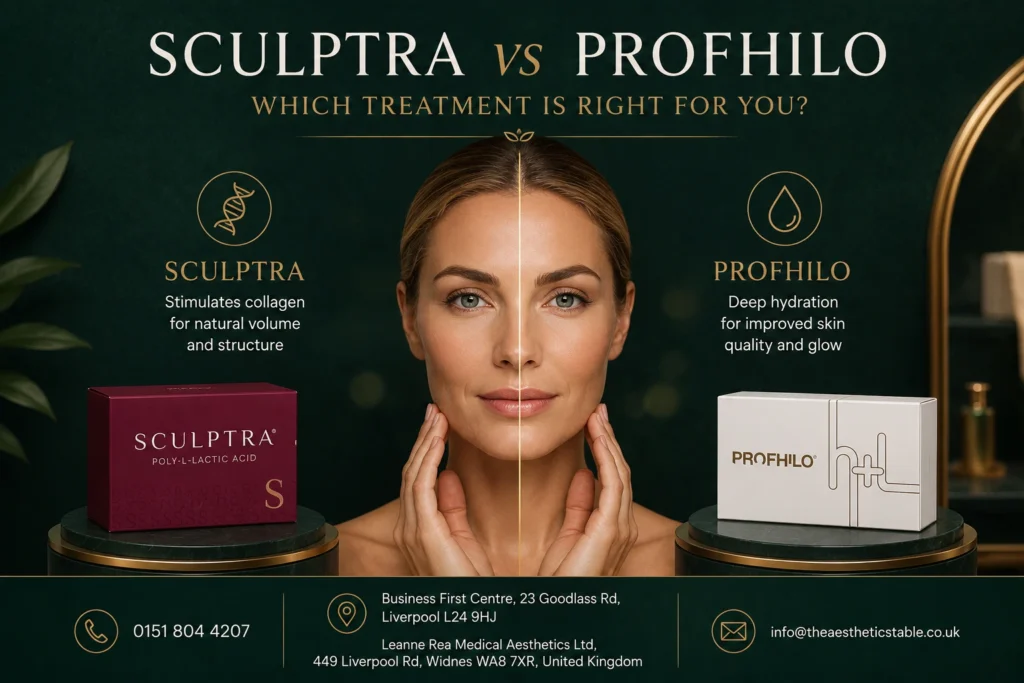
Sculptra vs Profhilo is one of the questions we hear most often at The Aesthetics Table. Both are injectable treatments that address signs of ageing and produce natural-looking results, but they work in completely different ways and are suited to different concerns.
Choosing the wrong treatment for your skin is the most common reason people feel underwhelmed by aesthetic results. This Sculptra vs Profhilo guide explains how each treatment works, what it’s best suited for, and how we approach this decision with clients across Liverpool.
What Is Sculptra, and How Does It Work?
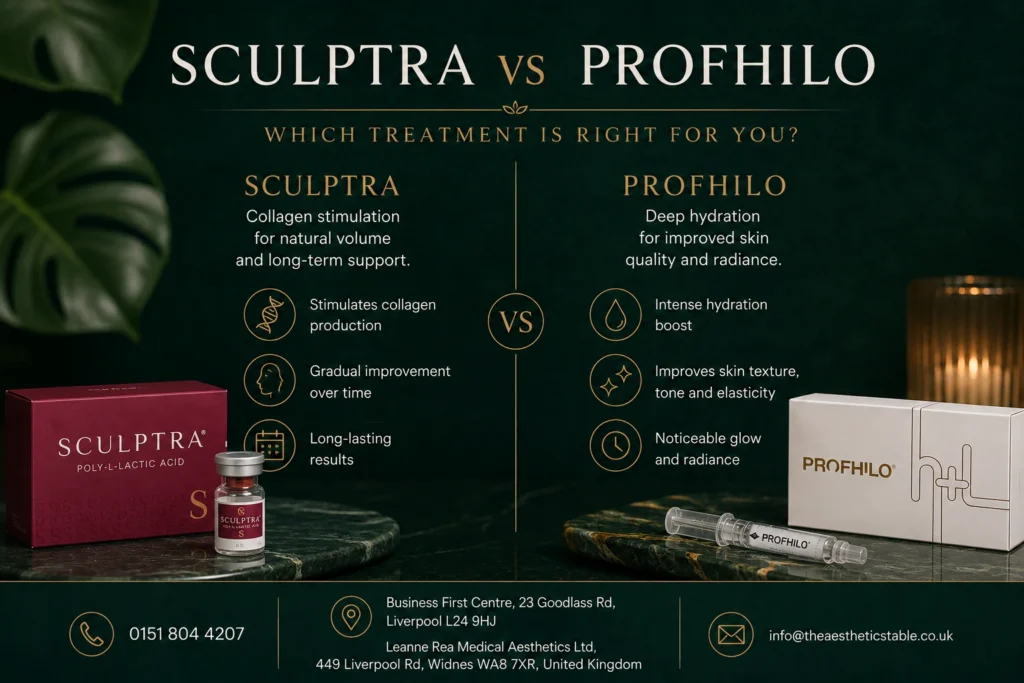
Sculptra is an injectable collagen stimulator made from Poly-L-Lactic Acid (PLLA), a biocompatible substance that triggers the body’s own fibroblasts to produce new collagen over time. Unlike traditional fillers, it doesn’t add immediate volume. It gradually rebuilds the skin’s underlying support structure.
What to expect with Sculptra:
- 2 to 3 sessions, spaced 4 to 6 weeks apart
- Results emerge gradually, with the most visible improvements appearing around 3 to 6 months after the first session
- Results can last up to 24 months, sometimes longer
- Stimulates Type I collagen, the structural collagen responsible for skin firmness and resilience
At The Aesthetics Table, we use Sculptra for clients experiencing real structural changes hollowing through the cheeks, softening of the jawline, or that general sense that the face has “deflated” with age. Clients who commit to the full course consistently tell us it’s the most natural-looking improvement they’ve had. It rewards patience, and the results hold.
For more details, visit the Galderma Sculptra information page or our Sculptra Liverpool page.
What Is Profhilo, and How Does It Work?
Profhilo is an injectable skin remodelling treatment made from highly concentrated, ultra-pure hyaluronic acid. It’s not a filler — it spreads evenly beneath the skin, delivering deep hydration while stimulating collagen and elastin production. The result is improved skin quality, texture, and elasticity from the inside out.
What to expect with Profhilo:
- 2 sessions, spaced 4 weeks apart (a third is sometimes recommended for significant laxity or dehydration)
- Improved skin radiance and hydration are often visible within 2 to 4 weeks of the first session
- Full results typically apparent 4 weeks after the second session
- Results last around 6 months, with maintenance treatments recommended twice a year
- Delivered via 5 injection points on each side of the face using the BAP technique, minimising discomfort
In our Liverpool clinic, Profhilo is most popular with clients in their mid-thirties to early fifties who feel their skin has become dull, dry, or lost its natural glow. Clients regularly describe the results as looking “like themselves, but well-rested.”
Read more on our Profhilo Liverpool page.
Sculptra vs Profhilo: The Core Difference
Sculptra rebuilds structure. Profhilo rebuilds skin quality.
Sculptra addresses collagen loss deep within the facial tissue, the gradual decline that leads to volume reduction, structural softening, and laxity. Profhilo addresses the surface layer dehydration, dullness, reduced elasticity, and loss of skin quality.
Both work with the body’s own repair mechanisms. Neither alters your features dramatically. But in the Sculptra vs Profhilo decision, they are not interchangeable the right choice always comes down to your specific concerns.
Sculptra vs Profhilo: At a Glance
| Sculptra | Profhilo | |
|---|---|---|
| Main ingredient | Poly-L-Lactic Acid (PLLA) | Ultra-pure hyaluronic acid |
| Primary purpose | Collagen stimulation, structural support | Skin hydration, quality, and elasticity |
| Best for | Volume loss, laxity, facial structure | Dull, dehydrated, crepey, or tired skin |
| Sessions needed | 2–3 (every 4–6 weeks) | 2 (4 weeks apart) |
| When results appear | 3–6 months (gradual) | 2–4 weeks after first session |
| How long results last | Up to 24 months | Around 6 months |
| Alters facial features? | No | No |
| Can they be combined? | Yes | Yes |
Which Treatment Is Better for Skin Quality?
If your main concern is skin condition rather than structure, Profhilo is almost always our first recommendation.
Clients who benefit most from Profhilo typically describe skin that feels or looks:
- Dehydrated or tight despite regular moisturising
- Dull, flat, or lacking its previous radiance
- Crepey in texture, particularly around the eyes, neck, or décolletage
- Less elastic, slower to spring back
- Generally tired regardless of sleep
Profhilo addresses the underlying tissue dehydration that topical skincare can’t fully reach. If skin quality is your priority, our guide to the best skin treatments for dull and tired-looking skin is also worth reading.
Which Treatment Is Better for Facial Volume Loss?
For clients experiencing structural changes, hollowing, deflation, or softening of facial contours, Sculptra is usually the more appropriate option.
Concerns that respond well to Sculptra include:
- Hollowing of the cheeks or under-eye area
- Loss of jawline or chin definition
- Mid-face flattening or reduced facial dimension
- Mild to moderate skin laxity in the lower face
- Gradual facial “deflation” that fillers have previously over-corrected
Sculptra is not a quick fix; the collagen-building process takes months. But the improvement is structural, genuine, and long-lasting. Clients who return for reviews 18 months after completing their course consistently tell us the results have held up better than they expected.
Do Both Treatments Look Natural?
Yes, but in different ways. With Sculptra, changes develop over months, so people around you adjust gradually. Friends often say you look well or refreshed without being able to explain why. With Profhilo, the improvement is subtler and faster, a healthier glow and better skin quality, with no change to your features or expressions.
In both cases, natural results come from selecting the right treatment for the right concern, which is exactly what the Sculptra vs Profhilo consultation at The Aesthetics Table is designed to clarify. We won’t recommend a treatment just because it’s popular or because it’s what you came in asking for.
Can Sculptra and Profhilo Be Combined?
Yes. Because they work at different tissue levels and address different concerns, the two treatments complement each other well. We sometimes describe it as treating the canvas and the paint. Sculptra restores the structural foundation underneath, and Profhilo improves the skin quality on top.
Whether a combined approach is appropriate depends on your concerns, skin condition, and budget, which we discuss fully during your consultation.
Which Treatment Suits Different Age Groups?
There’s no strict age rule, but the Sculptra vs Profhilo decision does follow certain patterns in our Liverpool clinic. Clients in their mid-thirties to mid-forties most often present with skin quality concerns, dehydration, reduced glow, and early elasticity loss, making Profhilo a natural starting point. Clients in their late forties and beyond more often show structural changes alongside skin quality concerns, making Sculptra or a combination approach more appropriate.
That said, age is a guide, not a rule. We’ve treated clients in their late thirties with significant volume loss who are ideal Sculptra candidates, and clients in their sixties for whom Profhilo is the better fit. A personalised assessment always matters more than age alone.
Alternative Treatments to Consider
While Sculptra vs Profhilo is the most common comparison we’re asked about, they are not the only options worth considering depending on your concerns.
Polynucleotides (PDRN)
Focused on cellular repair and skin regeneration. Particularly effective for skin quality, fine lines, and photo-ageing and an option for clients who cannot tolerate hyaluronic acid.
Find out more on our Polynucleotide Treatment Liverpool page.
Mesotherapy
Delivers a tailored blend of vitamins, amino acids, and hyaluronic acid directly into the skin. Works well for hydration and radiance, and as a preparatory treatment before Profhilo or Sculptra.
Read more on our Mesotherapy Liverpool page.
Skin Boosters
Products like Restylane Skin boosters or Juvederm Volite provide targeted localised hydration and differ from Profhilo in formulation and technique. Our Profhilo vs Skin Boosters guide covers the differences in detail.
Our Approach at The Aesthetics Table, Liverpool
We see clients for both Sculptra and Profhilo from across Liverpool and Merseyside, including Liverpool City Centre, Allerton, Childwall, Woolton, Mossley Hill, Aigburth, Gateacre, Hunts Cross, and West Derby.
Every treatment at The Aesthetics Table begins with a thorough consultation and facial assessment covering skin quality, facial structure, degree of volume loss, medical history, and your goals. We’ll be straightforward with you if a different treatment would serve you better.
If you’re weighing up Sculptra vs Profhilo, a consultation is a better starting point than a booking.
Frequently Asked Questions
Is Sculptra better than Profhilo?
Neither is objectively better. Sculptra is the stronger choice for facial volume loss, collagen decline, and structural ageing. Profhilo is better suited to improving skin hydration, elasticity, and skin quality. The right option depends on your specific concerns.
How much does Sculptra cost in Liverpool?
Pricing depends on the number of vials required and the sessions included in your plan. We discuss all costs in full during your initial consultation. Contact us for current pricing.
How much does Profhilo cost in Liverpool?
Profhilo pricing is confirmed during your consultation. A standard course covers two sessions, and we advise on maintenance based on your skin’s response. Get in touch for up-to-date information.
Can I have Sculptra and Profhilo at the same time?
In most cases, yes. Because they work at different tissue levels and address different concerns, they can be combined safely as part of a structured plan. Your practitioner will confirm suitability during your consultation.
How long does Sculptra last?
Up to 24 months, sometimes longer. Full results are typically visible 3 to 6 months after the first session, following a course of 2 to 3 treatments spaced 4 to 6 weeks apart.
How long does Profhilo last?
Around 6 months. Most clients have 2 sessions spaced 4 weeks apart and return for maintenance twice a year.
Is Profhilo a skin booster?
Profhilo is often grouped with skin boosters, but it works differently. It acts as a bioremodeller — spreading through the tissue and stimulating both collagen and elastin, rather than staying localised like most traditional skin booster products.
Can Sculptra help with skin laxity?
Yes. Sculptra is frequently chosen for mild to moderate skin laxity in the cheeks, jowls, and lower face. By stimulating new collagen, it improves the underlying support structure and helps skin appear firmer over time.
Which treatment is better for someone in their forties?
It depends on your concerns rather than your age. Clients in their forties may need Profhilo for skin quality, Sculptra for structural support, or both. A consultation is the most reliable way to find out.
Is Sculptra or Profhilo better for the neck and décolletage?
Profhilo is more commonly used for the neck and décolletage, where crepiness and elasticity loss are typical concerns. Sculptra can be used off-face in some cases, but your practitioner will advise on the most appropriate option.
Where can I get Sculptra or Profhilo in Liverpool?
Both treatments are available at The Aesthetics Table. We see clients from across Liverpool and Merseyside, including Allerton, Childwall, Woolton, Mossley Hill, Aigburth, Gateacre, and Hunts Cross. Book a consultation to get started.
Final Thoughts
When it comes to Sculptra vs Profhilo, both are excellent treatments, but they’re not interchangeable. Sculptra is built for structural concerns: collagen loss, volume reduction, and facial laxity. Profhilo is built for skin quality: hydration, radiance, and elasticity.
The right choice depends on your skin, not on trends. If you’re based in Liverpool or across Merseyside and want an honest assessment of which treatment suits you, we’d be glad to help.