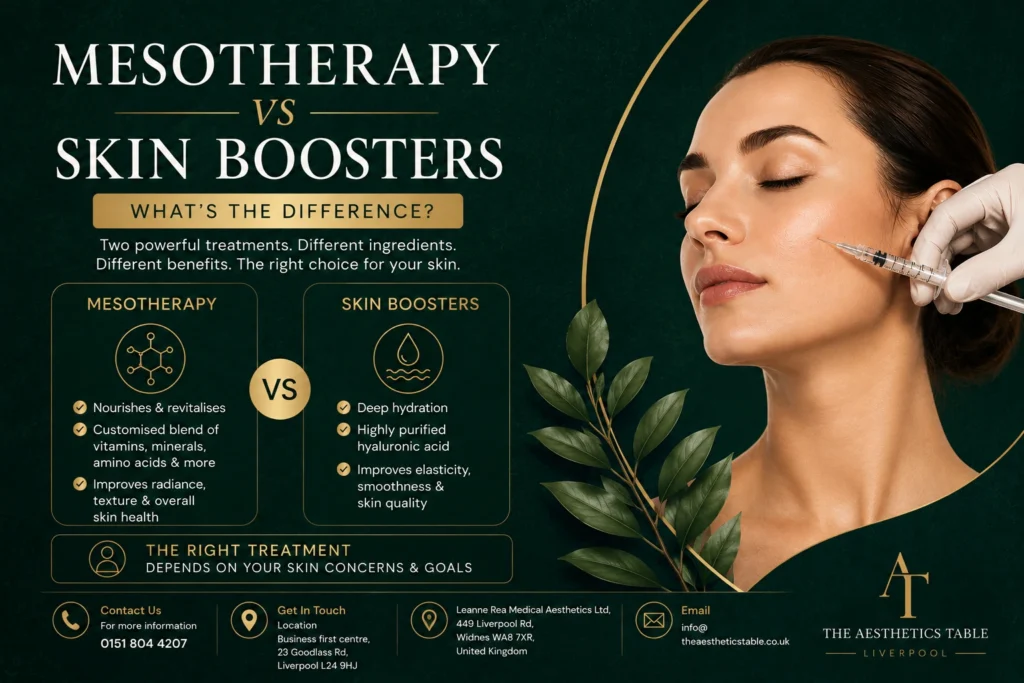
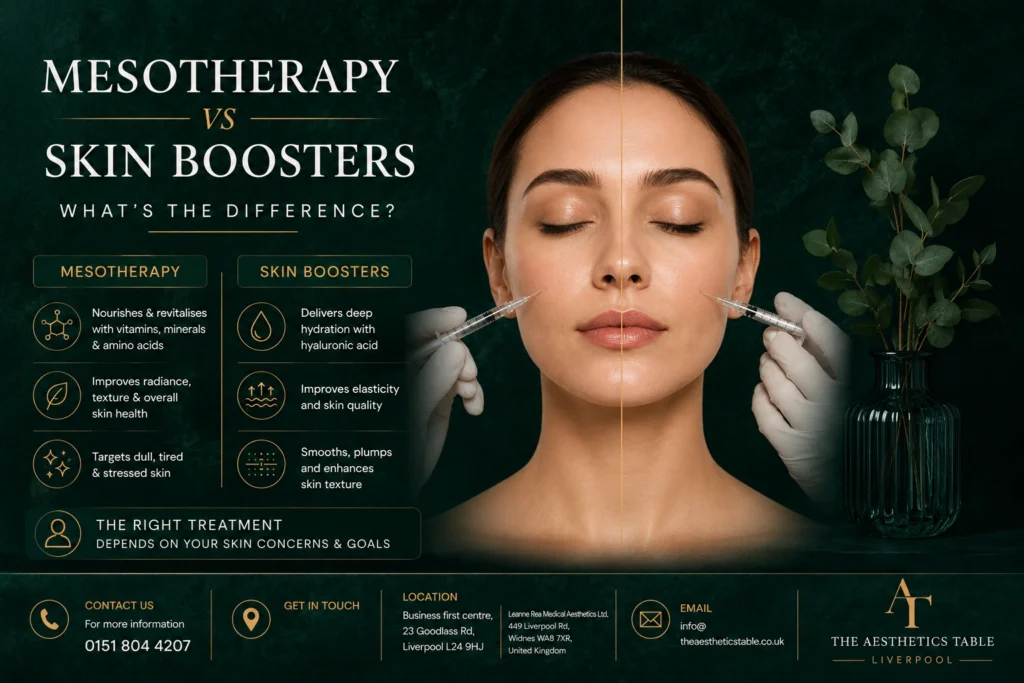
Mesotherapy vs skin boosters is a common question, and the answer is simple. Both are injectable skin treatments, but they do different jobs. Skin boosters flood the skin with hyaluronic acid for deep hydration and plumpness. Mesotherapy delivers a tailored cocktail of vitamins and nutrients to nourish and target concerns like dullness. Your skin type decides which fits.
Most people find these two treatments confusing. The names get used almost interchangeably online. Both involve tiny injections. Both promise brighter, healthier skin. So it is easy to assume they are the same thing with different labels.
They are not. Choosing the wrong one wastes money and leaves your actual concern untreated. If your skin is dehydrated and you pick a nutrient mesotherapy blend aimed at dullness, you will not get the hydration you need. The mesotherapy vs skin boosters decision is really a question about what your skin is missing.
This guide breaks down what each treatment does, how they differ, and which suits which concern. It is written to help you walk into a consultation already knowing the right questions to ask.
What this guide covers
You will learn what skin boosters and mesotherapy actually are, how they differ in ingredients and purpose, and how long each lasts. We map treatments to specific concerns like dryness, dullness, and pigmentation. We cover sessions, comfort, downtime, and whether combining them makes sense.
We do not cover exact clinic pricing here. Costs vary by area and product, so we give honest ranges and explain what drives them. For a personalised quote, a consultation is the only accurate source.
What are skin boosters?
Skin boosters are injectable treatments that deliver stabilised hyaluronic acid into the deeper layers of your skin. Hyaluronic acid is a substance your body makes naturally to hold water. The injections restore hydration, improve elasticity, and give a plumper, smoother look from within.
People often call them an injectable moisturiser. That captures the idea well. Rather than sitting on the surface like a cream, the hyaluronic acid works inside the dermis, drawing and holding water where it counts.
Common treatment areas include the face, neck, décolletage, and hands. Well-known products in this category include Profhilo, Juvederm Volite, and Seventy Hyal 2000. Each has a slightly different formulation and longevity, but the goal is shared: better skin quality through deep hydration.
What is mesotherapy?
Mesotherapy delivers a customised blend of vitamins, minerals, amino acids, and antioxidants into the middle layer of the skin, called the mesoderm. Unlike skin boosters, which focus on hydration, mesotherapy nourishes the skin and can target a broader range of concerns depending on the mix used.
The treatment was developed in France in the 1950s and has evolved a great deal since. Because the cocktail is adjustable, it is versatile. A practitioner can tailor the blend to your concern rather than using a single fixed product.
This flexibility is the point. If skin boosters are about water, mesotherapy is about food. It feeds the skin with active ingredients chosen for what your skin lacks, whether that is radiance, nourishment, or support for specific issues.
What is the difference between mesotherapy vs skin boosters?
The core difference is purpose. Skin boosters hydrate and rebuild the skin’s water structure using hyaluronic acid. Mesotherapy nourishes using a nutrient cocktail and can be customised for concerns beyond hydration. One rebuilds moisture. The other feeds and corrects.
There is also a difference in depth and delivery. Skin boosters are usually placed in the superficial to mid dermis. Mesotherapy targets the mesoderm using multiple tiny injections spread across the area.
Ingredients differ too. Skin boosters rely on stabilised hyaluronic acid, which lasts longer with fewer sessions. Mesotherapy uses a broader mix that is metabolised faster, so it typically needs more frequent maintenance. Neither approach is better in the abstract. They simply solve different problems.
Which treatment lasts longer?
Skin boosters generally last longer per treatment cycle. Depending on the product, results can hold for six to nine months. Mesotherapy results usually last three to six months and rely on regular maintenance sessions. Longer duration does not make a treatment better, only different in rhythm.
The reason comes down to the ingredients. Stabilised hyaluronic acid in skin boosters breaks down slowly, so the effect is sustained. Mesotherapy’s nutrient blend is used up faster as the skin absorbs it. In the mesotherapy vs skin boosters comparison, longer duration does not automatically mean better.
This matters for planning and budget. If you want fewer appointments and longer gaps, skin boosters suit that pattern. If you are happy with a maintenance rhythm and want the targeted nourishment mesotherapy offers, the shorter cycle is part of the deal, not a flaw.
Which one suits your skin concern?
Match the treatment to what your skin is missing. Choose skin boosters for dehydration, loss of elasticity, or crepey texture. Choose mesotherapy for dullness, tired-looking skin, or when you want targeted nourishment. Your primary concern, not the treatment’s popularity, should drive the choice. The mesotherapy vs skin boosters choice depends on what your skin is missing.
Best for dryness and dehydration
If your skin feels tight, looks dull from lack of moisture, or shows fine lines that soften when you moisturise, hydration is your issue. Skin boosters are usually the better fit here. The hyaluronic acid holds water in the dermis and improves suppleness over a few weeks.
Best for dullness and tired skin
When skin looks flat, grey, or lifeless despite being reasonably hydrated, it often needs nourishment rather than water. Mesotherapy suits this well. The vitamin and antioxidant blend supports radiance and can lift a tired complexion relatively quickly.
Best for pigmentation and acne scarring
Mesotherapy has the edge for these because the blend can be tailored to target them. It is not a guaranteed fix, and results vary. A proper assessment matters, because pigmentation in particular can have several causes that respond to different treatments.
How do mesotherapy and Profhilo compare?
Profhilo is a specific skin booster, so the mesotherapy vs Profhilo question is really nutrition versus hydration. Profhilo uses high-concentration hyaluronic acid to hydrate and stimulate collagen across the whole area. Mesotherapy delivers a nutrient blend for nourishment. Profhilo lasts longer. Mesotherapy is more customisable.
Profhilo stands out among skin boosters because it spreads under the skin rather than staying at each injection point, which improves overall firmness. It typically involves two initial sessions a month apart.
Mesotherapy involves more injections and more frequent upkeep, but it offers flexibility. If you want a single, proven hydration and firmness product, Profhilo is a strong option. If you want a tailored nourishment approach, mesotherapy may be a better fit. Many people compare these alongside Profhilo and skin boosters more broadly.
How many sessions will you need?
Skin boosters usually need one to three initial sessions spaced a few weeks apart, then maintenance every six to nine months. Mesotherapy typically needs a course of three to six sessions close together at first, then top-ups every few months. Your practitioner sets the exact plan after assessing your skin.
The difference reflects how each treatment works. Skin boosters build a hydration reserve that lasts, so fewer sessions are needed once established. Mesotherapy layers nourishment gradually, which is why the early course is more intensive.
Do not judge either by the first session alone. Both build cumulatively. Skin boosters in particular take two to four weeks to show full results, so patience is part of the process. Session numbers are one more area where mesotherapy vs skin boosters differ.
Does either treatment hurt, and is there downtime?
Both use fine needles, so discomfort is mild for most people. Numbing cream can be applied first. Downtime is minimal. You may have small bumps, redness, or minor bruising at injection sites for a day or two. Most people return to normal activities the same day.
Mesotherapy involves more injection points, so some people find it slightly more noticeable. The sensation is usually described as small pinches rather than pain.
The temporary bumps from skin boosters settle within 24 to 48 hours as the product integrates. Avoid makeup, heat, and strenuous exercise for the rest of the treatment day. These are gentle treatments, which is part of their appeal, but they are still medical procedures and deserve a proper aftercare routine. On comfort, the mesotherapy vs skin boosters difference is small.
Can you combine mesotherapy and skin boosters?
Yes, in some cases, combining them addresses both hydration and nourishment more completely than either alone. It is not a default recommendation. Combining only makes sense when your skin genuinely needs both, and a practitioner should confirm this after assessing your concerns rather than selling a package.
The logic is simple. If your skin is both dehydrated and dull, one treatment restores water while the other feeds it. Sequenced correctly, they complement each other.
The risk is overtreatment. Doing both when you only needed one wastes money and adds unnecessary appointments. A good practitioner will tell you when one treatment is enough. Honest advice here matters more than an upsell. Sometimes the mesotherapy vs skin boosters question is not either-or at all.
How much do they cost?
Costs vary by area, product, and number of sessions. As a general UK guide, skin booster sessions often range from around 150 to 350 pounds each, with course pricing available. Mesotherapy sessions typically fall in a similar range but need more sessions upfront. A consultation gives the only accurate figure.
Price should not be the only factor. A cheaper treatment that does not address your concern is not a saving. Focus first on which treatment fits your skin, then on cost. Cost is often the final factor in the mesotherapy vs skin boosters decision.
Be cautious of prices that seem far below the market. These are medical treatments performed with prescription-grade products by trained practitioners. Very low pricing can signal inexperience or poor product quality.
Mesotherapy vs skin boosters: which should you choose?
Choose skin boosters if your main concern is dehydration, elasticity, or crepey texture and you want longer-lasting results with fewer sessions. Choose mesotherapy if your concern is dullness or you want targeted nourishment and are comfortable with more frequent upkeep. When unsure, a consultation settles it.
There is no universal winner. The right choice is the one that matches what your skin needs today. The mesotherapy vs skin boosters decision always comes back to your main concern. Your budget, your tolerance for appointments, and your primary concern all feed into it.
If you are still unsure after reading this, that is normal. An in-person assessment of your skin will give a clear answer that no article can. You can explore skin booster treatment options or bring these questions to a consultation.
Whichever treatment you choose, make sure your practitioner is properly qualified. You can check the register of trained practitioners on the JCCP website.
Frequently asked questions
No. Skin boosters use hyaluronic acid to hydrate and plump the skin. Mesotherapy uses a nutrient cocktail to nourish and target concerns like dullness. They share the injectable format but deliver different results, so they suit different skin needs.
Skin boosters usually last longer, around six to nine months depending on the product. Mesotherapy results typically last three to six months and need more frequent maintenance. The difference comes from how quickly the skin absorbs each treatment’s ingredients.
It depends on the sign of ageing. For dehydration and loss of firmness, skin boosters usually suit better. For dullness and tired-looking skin, mesotherapy can help more. Many ageing concerns respond best to a plan assessed in person.
Both involve fine needles and cause only mild discomfort for most people. Numbing cream can be applied first. Mesotherapy uses more injection points, so some find it slightly more noticeable, but neither is considered painful.
Mesotherapy often shows brightness fairly quickly, within a week or two. Skin boosters take longer, usually two to four weeks, because the hyaluronic acid integrates and draws water gradually. Both build further over a course of sessions.
Most clinics do not offer injectable aesthetic treatments during pregnancy or breastfeeding as a precaution. Always tell your practitioner. They will recommend waiting and suggest suitable skincare in the meantime.
Value depends on your concern, not the price alone. A treatment that matches your skin need is better value even if it costs more, because it actually works. The wrong cheaper treatment solves nothing.
Identify your main concern first. Tight, dehydrated skin points to skin boosters. Dull, tired skin points to mesotherapy. If your skin shows both, a consultation will confirm whether one treatment or a combination fits best.
Conclusion
The mesotherapy vs skin boosters choice comes down to one question: does your skin need water or nourishment? Skin boosters hydrate and last longer. Mesotherapy nourishes and offers more customisation. Neither is universally better.
Your primary concern should decide. If you are ready to move forward, the clearest next step is an assessment of your skin in person. Explore skin booster treatment at our Liverpool clinic to see if it fits your goals.
Written by Leanne Rea, Registered Adult Nurse (NMC), about the author.