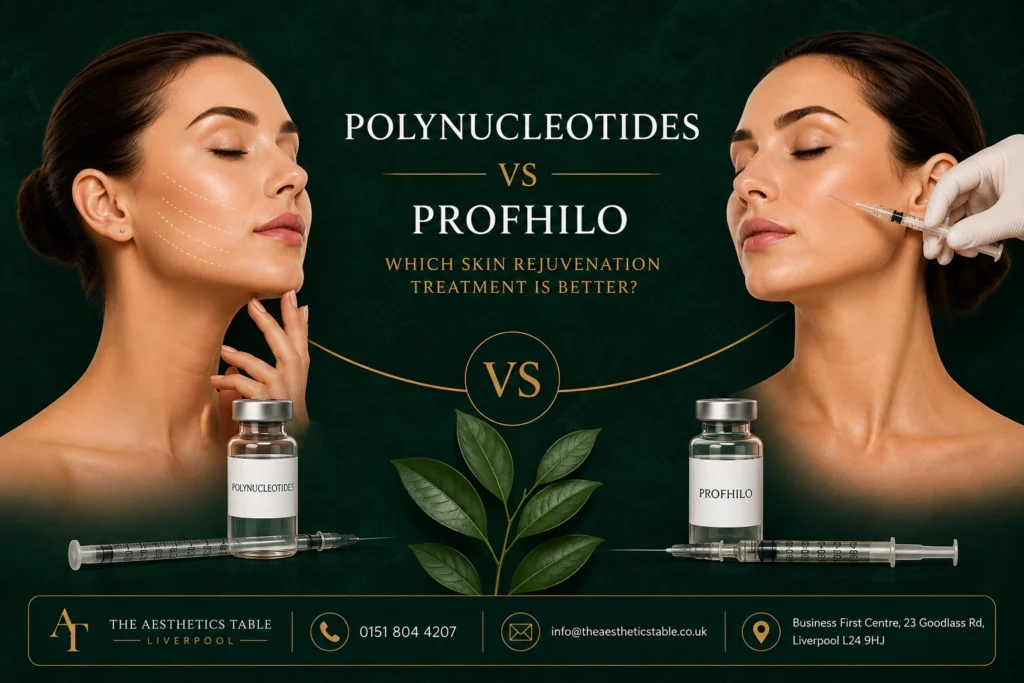
Polynucleotides vs Profhilo is one of the most searched treatment comparisons in aesthetic medicine right now, and for good reason. Both are advanced injectable skin treatments. Both are non-surgical. Both produce natural-looking improvements without altering facial structure. But they work through completely different biological mechanisms, and for most patients, one is clearly more appropriate than the other.
This guide covers everything you need to know about polynucleotides vs Profhilo, how each treatment works, what products are used, what results to expect, who each treatment suits, and how we help patients across Liverpool make the right decision for their skin.
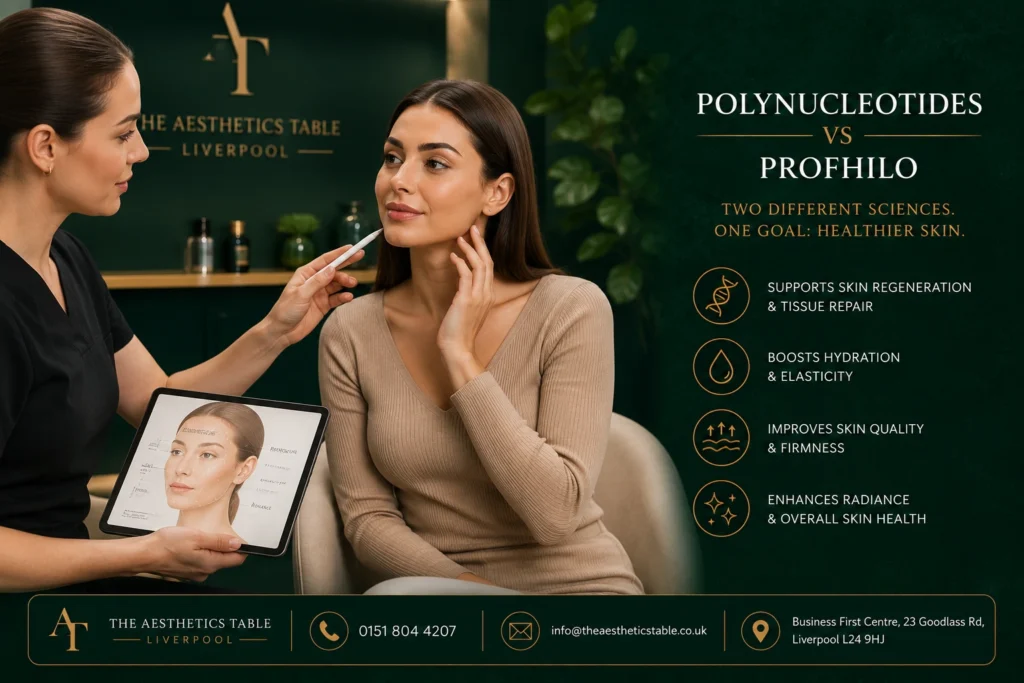
Why People Compare Polynucleotides and Profhilo
The confusion is understandable. Both treatments are injectable, both are non-surgical, both improve skin quality, and both are commonly recommended as part of anti-ageing treatment plans. Online, they’re often grouped under terms like “skin rejuvenation” or “advanced injectables”, which doesn’t help when you’re trying to work out which one is right for you.
The polynucleotides vs Profhilo comparison really comes down to one key question: does your skin need hydration and remodelling, or does it need cellular repair and regeneration? Those are different needs, and they respond to different treatments. Understanding that distinction is what makes the comparison worth going through carefully before you book anything.
What Is Profhilo?
Profhilo is an injectable skin remodelling treatment made from one of the highest concentrations of hyaluronic acid available in an aesthetic product 64mg of pure BDDE-free hyaluronic acid per 2ml syringe. Unlike conventional dermal fillers, Profhilo is not designed to add volume or change facial structure. Instead, it spreads naturally through the skin once injected, working across a wide area to hydrate and stimulate the production of collagen and elastin.
The treatment is administered using the BAP (Bio Aesthetic Point) technique five injection points on each side of the face, making it a low-trauma, quick procedure with minimal discomfort for most patients. It’s manufactured by IBSA and is one of the most clinically studied injectable skin treatments currently available in the UK.
Profhilo suits patients who are experiencing:
- Dehydrated or dull skin lacking glow and plumpness
- Crepey skin texture, particularly around the cheeks, jawline, and neck
- Reduced skin elasticity and early signs of skin laxity
- Loss of radiance without significant volume loss
- Skin quality decline, which topical products are no longer addressing
A standard Profhilo course involves two sessions spaced four weeks apart, with visible results typically appearing within two to four weeks of the first session. Clinical studies, including those published by IBSA, support results lasting up to six months, with most patients returning for a single maintenance session every six months thereafter.
You can find full treatment details on our Profhilo treatment page. If you’re also weighing up other options, our post on powerful Profhilo alternatives for skin rejuvenation is worth reading alongside this one.
What Are Polynucleotides?
Polynucleotides (also known as PDRN polydeoxyribonucleotide) are regenerative injectable treatments derived from purified salmon or trout DNA. Rather than delivering moisture or volume into the skin, they work at a cellular level by stimulating fibroblast activity the cells responsible for producing collagen and elastin and supporting the skin’s natural repair processes.
The mechanism is distinct from any other injectable treatment available today. Polynucleotides don’t fill, hydrate, or lift in the traditional sense. Instead, they provide the biological signals that encourage the skin to function better and repair more effectively on its own. This makes them particularly well-suited to patients dealing with structural skin quality decline, not just surface-level dehydration.
Well-established polynucleotide products used in professional clinics include:
- Nucleofill: available in multiple concentrations, widely used for face, neck, and periorbital (under-eye) rejuvenation
- Plinest: a highly purified PDRN product with strong clinical evidence for skin regeneration and tissue repair
- Ejal: combines polynucleotides with hyaluronic acid for both regeneration and hydration benefits
- Newest: targets fine lines and skin quality in delicate areas, including the under-eye zone
Because polynucleotides work by supporting biological repair rather than introducing a filler substance, they are particularly effective for patients concerned about:
- Declining skin quality that has not responded well to hydration-based treatments
- Fine lines and skin laxity, particularly around the eyes and perioral area
- Under-eye hollowing, dark circles related to skin thinning, and crepey texture
- Skin that has been affected by environmental damage, stress, or lifestyle factors
- Long-term skin health and structural improvement rather than short-term results
A typical polynucleotide course involves three to four sessions spaced two to three weeks apart, with results becoming progressively visible as fibroblast stimulation builds over time. Most patients notice meaningful improvement in skin quality, texture, and firmness after completing the initial course. Results are generally sustained for six to nine months, with maintenance sessions recommended one to two times per year.
Full details are available on our polynucleotide treatment Liverpool page.
Polynucleotides vs Profhilo: Side-by-Side Comparison
| Polynucleotides | Profhilo | |
|---|---|---|
| Primary mechanism | Cellular regeneration and tissue repair | Deep hydration and skin remodelling |
| Main ingredient | Purified PDRN (salmon/trout DNA) | 64mg BDDE-free hyaluronic acid |
| How it works | Stimulates fibroblasts and biological repair | Spreads through skin to hydrate and stimulate collagen/elastin |
| Example products | Nucleofill, Plinest, Ejal, Newest | Profhilo by IBSA |
| Sessions (initial course) | 3–4 sessions, 2–3 weeks apart | 2 sessions, 4 weeks apart |
| Results visible | Progressively after each session | Within 2–4 weeks of session 1 |
| Results duration | 6–9 months | Up to 6 months |
| Best for | Regeneration, tissue repair, under-eye, laxity | Hydration, skin quality, elasticity, glow |
| Suitable for under-eye area | Yes widely used | Limited hyaluronic acid risk in the periorbital area |
| Adds volume | No | No |
| Alters facial structure | No | No |
| Can be combined | Yes | Yes |
Which Treatment Is Better for Skin Hydration?
When hydration is the primary concern, the polynucleotides vs Profhilo comparison clearly favours Profhilo. Its ultra-high concentration of hyaluronic acid spreads beneath the skin to attract and retain moisture across a wide treatment area. Patients experiencing chronically dry skin, loss of glow, or dehydrated skin that no longer responds to topical moisturisers typically see the most pronounced improvements with Profhilo.
That said, some polynucleotide products, particularly Ejal, which combines PDRN with hyaluronic acid, can contribute to hydration improvement alongside their regenerative benefits. If dehydration is your primary concern, but you also have underlying skin quality concerns, discussing a combination approach during consultation is worth doing.
Which Treatment Is Better for Skin Regeneration and Tissue Repair?
For regeneration, tissue repair, and long-term skin health, polynucleotides vs Profhilo tips clearly in favour of polynucleotides. Because they work by stimulating fibroblast activity and supporting the skin’s own repair mechanisms, the improvements they produce are structural rather than surface-level. Patients often describe the results as their skin functioning better and behaving younger, a different quality of change from what hydration-focused treatments produce.
This is particularly relevant for patients in Liverpool who have spent years dealing with the effects of environmental exposure, stress, and lifestyle factors that gradually deplete skin quality over time. Polynucleotides address those underlying concerns more directly than a hydration treatment can.
Which Treatment Is Better for the Under-Eye Area?
The under-eye area is one of the most common reasons patients come to us specifically asking about the polynucleotides vs Profhilo comparison and it’s one of the clearest distinctions between the two treatments.
Polynucleotides are generally the preferred option for under-eye rejuvenation. Products like Nucleofill and Newest are formulated for use in the periorbital area, where the skin is thinner and more delicate than anywhere else on the face. Because polynucleotides stimulate cellular repair rather than introducing a substance that holds water, they carry a lower risk of complications in this sensitive zone.
Profhilo, while excellent for the cheeks, jawline, neck, and décolletage, is not routinely recommended for the under-eye area by most experienced practitioners. The concentration of hyaluronic acid it contains can create unwanted swelling or visibility in very thin skin, particularly if the patient has poor lymphatic drainage. This is a nuance that matters significantly when choosing between the two treatments, and it’s one of the reasons why a proper consultation is so important.
Which Treatment Is Better for Anti-Ageing?
Both treatments address visible signs of ageing, but they do so through different mechanisms and at different stages of the ageing process.
Profhilo tends to be most effective for patients in their mid-thirties to mid-forties who are noticing early skin quality decline loss of radiance, dehydration, reduced firmness but whose skin still has reasonable structural integrity. At this stage, deep hydration and biostimulation can produce very visible improvements.
Polynucleotides tend to be more appropriate for patients dealing with more established signs of ageing fine lines, skin laxity, tissue thinning, and structural changes that hydration alone won’t address. They’re also increasingly used as a preventative treatment in younger patients with a strong family history of premature skin ageing.
For broader anti-ageing concerns, our anti-ageing treatment page offers a wider overview of the options available at The Aesthetics Table.
Which Treatment Produces Longer-Lasting Results?
In the polynucleotides vs Profhilo comparison, polynucleotides generally sustain results for longer six to nine months compared to Profhilo’s six months though direct comparison is complicated by the fact that they’re achieving different outcomes.
Profhilo results reflect ongoing hydration and collagen stimulation, which naturally diminish as the hyaluronic acid is metabolised. Polynucleotide results reflect structural improvement in fibroblast activity and tissue quality, which can be more durable because the changes are partly intrinsic to the skin itself rather than dependent on an external substance remaining in place.
According to clinical guidance from the British College of Aesthetic Medicine, the longevity of injectable aesthetic results depends heavily on individual biological factors, including age, skin condition, lifestyle, and treatment history, which is why results vary between patients even using the same product.
Can Polynucleotides and Profhilo Be Combined?
Yes, and in some cases, combining the two treatments produces more comprehensive results than either alone. Because polynucleotides vs Profhilo target different aspects of skin health, a combined approach can address both cellular regeneration and hydration simultaneously.
In practice, this might mean completing a polynucleotide course for regeneration and tissue repair while spacing Profhilo sessions to maintain hydration and skin quality in parallel. At The Aesthetics Table, we only recommend combination treatment when a patient’s skin condition and goals genuinely support it.
We assess this properly during consultation rather than applying a default protocol. If you’re curious whether combination treatment is right for you, that conversation starts with a skin consultation and scanner assessment.
Alternative Treatments Worth Considering
If neither polynucleotides nor Profhilo feels like the right fit after reading the comparison, several other treatments at The Aesthetics Table are worth exploring.
Skin Boosters
Skin boosters including products like Juvederm Volite, Restylane Vital, and Sunekos use injectable hyaluronic acid to improve hydration and skin quality. They sit in a similar category to Profhilo but typically use a more targeted injection technique and are available in a wider range of formulations. You can also read our detailed comparison of Profhilo vs skin boosters for more on the differences.
Mesotherapy
Mesotherapy delivers a customised blend of vitamins, amino acids, antioxidants, and hyaluronic acid into the skin through micro-injections. It’s particularly well suited to patients whose skin looks dull, tired, or undernourished rather than primarily dehydrated or structurally compromised.
Sculptra
Sculptra is a collagen stimulator that works by introducing poly-L-lactic acid into the skin, triggering a gradual collagen-building response over several months. It tends to be recommended for patients dealing with more significant volume loss and structural changes rather than surface-level skin quality concerns.
Laser Skin Rejuvenation
Where pigmentation, texture, or tone are the primary concerns, laser skin rejuvenation can produce improvements that injectable treatments alone cannot achieve. It’s often used alongside polynucleotides or Profhilo as part of a more comprehensive skin health plan.
How We Approach This Decision at The Aesthetics Table, Liverpool
The polynucleotides vs Profhilo decision isn’t one we make on behalf of patients before we’ve properly assessed their skin. Two people who both describe their skin as ageing or tired may have completely different underlying concerns and recommending the same treatment to both would be the wrong approach.
At The Aesthetics Table, every treatment recommendation is based on a proper skin assessment using our clinical skin scanner, a detailed conversation about your goals and concerns, and an honest evaluation of which treatment or combination of treatments is most likely to produce the results you’re looking for. We don’t apply a one-size-fits-all approach, and we don’t recommend treatments that aren’t genuinely suited to your skin.
Our clinical team brings professional qualifications in aesthetic medicine and hands-on experience treating patients with a wide range of skin concerns across Liverpool. We see patients regularly from Allerton, Childwall, Woolton, Mossley Hill, Aigburth, Hunts Cross, Sefton Park, and Liverpool City Centre. If you’re unsure which direction to take, a consultation is always the right starting point.
Frequently Asked Questions
Are polynucleotides better than Profhilo?
Neither polynucleotides nor Profhilo is universally better the right choice in the polynucleotides vs Profhilo comparison depends entirely on your skin concerns and goals. Profhilo is generally more appropriate when hydration, radiance, and overall skin quality are the primary concerns. Polynucleotides are generally more appropriate when the goal is cellular regeneration, tissue repair, or under-eye rejuvenation. A professional skin assessment is the most reliable way to determine which treatment suits your individual situation.
What is the main difference between polynucleotides and Profhilo?
The core difference between polynucleotides vs Profhilo is their mechanism of action. Profhilo delivers 64mg of highly concentrated hyaluronic acid into the skin to improve hydration, elasticity, and collagen stimulation. Polynucleotides deliver purified PDRN derived from salmon or trout DNA that stimulates fibroblast activity and supports cellular repair at a biological level. Profhilo addresses surface and structural skin quality; polynucleotides address how the skin functions and regenerates.
Can I have polynucleotides and Profhilo at the same time?
In some cases, yes. Because the two treatments target different aspects of skin health regeneration on one hand and hydration on the other combining them can produce more comprehensive results than either treatment alone. Whether a combined approach is appropriate for you depends on your skin condition, treatment history, and goals, which we assess during your consultation at The Aesthetics Table.
Are polynucleotides good for the under-eye area?
Yes, polynucleotides are one of the most commonly used treatments for under-eye rejuvenation. Products such as Nucleofill and Newest are specifically formulated for the periorbital area, where the skin is thinner and more sensitive than elsewhere on the face. Because they stimulate cellular repair rather than introducing a water-attracting substance, they carry a lower risk of complications in this delicate zone than hyaluronic acid-based treatments.
Is Profhilo a skin booster?
Profhilo is often grouped with skin boosters because it contains hyaluronic acid and improves hydration, but it is technically a distinct product category. Unlike conventional skin boosters, which are injected at multiple points across the treatment area, Profhilo is administered using the BAP technique at five points per side of the face and relies on its ultra-high concentration and specific formulation to spread naturally through the tissue. Its biostimulating effect on collagen and elastin also goes beyond what most traditional skin boosters achieve. Our Profhilo vs skin boosters comparison covers these differences in detail.
Which treatment is better for skin hydration?
Profhilo is the more targeted hydration treatment in the polynucleotides vs Profhilo comparison. Its 64mg hyaluronic acid concentration is among the highest available in any injectable aesthetic product, and its ability to spread through the skin makes it highly effective at restoring moisture levels across a wide area. For patients whose primary complaint is dry, dull, or dehydrated skin, Profhilo tends to produce more immediately noticeable hydration improvements than polynucleotides.
Which treatment is better for skin regeneration?
Polynucleotides are the stronger option for regeneration in the polynucleotides vs Profhilo comparison. By stimulating fibroblast activity and supporting the skin’s natural cellular repair processes, they produce structural improvements in skin quality that go beyond what hydration-based treatments can achieve. They’re particularly effective for patients dealing with fine lines, skin laxity, tissue thinning, or skin damage that hasn’t responded well to conventional injectable options.
How many sessions will I need?
Session requirements differ between the two treatments. Profhilo requires two sessions spaced four weeks apart for the initial course, with a single maintenance session typically every six months. Polynucleotides require three to four sessions spaced two to three weeks apart, with results lasting six to nine months and maintenance sessions one to two times per year. Your specific plan will be confirmed during your consultation at The Aesthetics Table based on your skin condition and goals.
Is there any downtime after polynucleotides or Profhilo?
Both treatments involve minimal downtime this is one area where polynucleotides vs Profhilo are very similar. Some redness, minor swelling, and small marks at injection sites are normal immediately after both treatments and typically settle within 24 to 48 hours. Most patients return to normal activities the same day. Polynucleotide treatments around the under-eye area may occasionally produce slightly more visible swelling in the first 24 hours, which resolves quickly. Full aftercare guidance is provided at your appointment.
Who is not suitable for these treatments?
Neither treatment is suitable during pregnancy or breastfeeding. Polynucleotides are not recommended for patients with a fish allergy, as most PDRN products are derived from salmon or trout DNA. Both treatments require a pre-treatment consultation to confirm suitability, identify any contraindications, and establish a personalised treatment plan. This is particularly important for patients with autoimmune conditions, active skin infections, or a history of allergic reactions to injectable treatments.
Final Thoughts
The polynucleotides vs Profhilo comparison doesn’t have a single right answer and anyone who tells you one treatment is always better than the other isn’t giving you the full picture. Profhilo excels at deep hydration, skin remodelling, and restoring the radiance and elasticity that gradually diminish with age. Polynucleotides excel at cellular regeneration, tissue repair, and improving the structural quality of skin that has declined in ways that hydration alone can’t address.
For many patients, the right answer is one or the other. For some, a combination of both sequenced properly and tailored to your specific skin produces the most comprehensive results.
If you’re ready to find out which treatment is right for you, book a consultation at The Aesthetics Table in Liverpool, and we’ll give you a clear, honest recommendation based on a proper assessment of your skin.